 GTA 6 GUIDE
Location Guide
Vice City: Leonida's Neon Capital
The Short Answer
Vice City is the main city of GTA 6 — a modern-day, fictionalised Miami in Vice-Dale County, state of Leonida. It is Lucia's home turf, the game's biggest urban area, and the neon beachfront city both trailers are built around. It is one region of a much larger state, not the whole map.
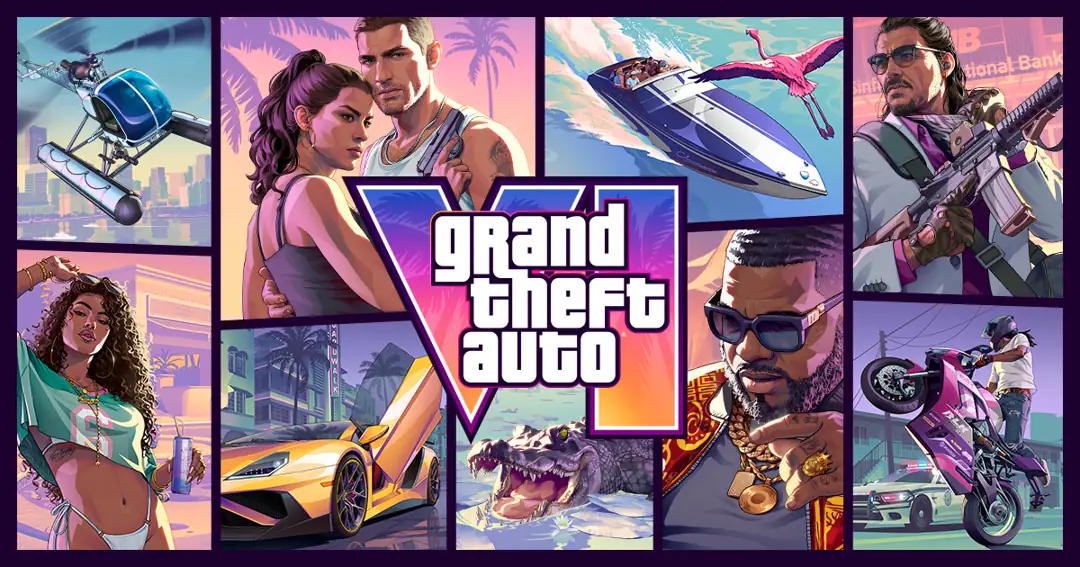
A modern Vice City
Players last saw Vice City in the 1980s of GTA: Vice City (2002) and Vice City Stories (2006). GTA VI's version is the same city dragged four decades forward: the art-deco beachfront and pastel neon survive, but the modern city adds glass condo towers, influencer culture, livestream chaos and the social-media satire that runs through both trailers. Rockstar positions it as the sunniest place in America with the darkest underbelly — 'Vice City, USA' is the game's own tagline for it.
Lucia's story is rooted here: she is released from Leonida Penitentiary into the city, and the conspiracy that swallows her and Jason radiates out from Vice City across the state. Where Jason's world is the Keys' marinas, Lucia's is the city's streets, clubs and rooftops.
What the trailers showed
- The beachfront strip — deco hotels, neon signage and crowded sand, the postcard image of the new Vice City.
- Downtown towers — a proper modern skyline, seen in helicopter shots and rooftop scenes.
- Marinas and waterways — yacht culture, boat thefts and chases through the canals.
- Street culture — car meets, dirt bikes and ATVs taking over intersections, convenience-store robberies filmed on phones.
- Nightlife — rooftop parties, clubs and the strip-club empire run by Boobie Ike, one of the city's confirmed characters.
Vice City vs the rest of Leonida
It is worth repeating because so much coverage gets it wrong: Vice City is not the whole map. It is the capital of a five-county state that includes island chains, swamp and farmland — see the full Leonida map guide. Think of Vice City as the game's Los Santos equivalent: the biggest single settlement, but one destination among several, connected by highways and causeways you will drive constantly as the story moves Jason and Lucia between the city and the Keys.
The city's two faces
Every GTA city is an argument about a real one, and Vice City's argument is about performance. The surface city — the one in the trailers' social-media clips — is all display: beach bodies, boat parties, supercars on the strip, rooftops at golden hour. The other city is the one the story lives in: cash businesses, club empires like Boobie Ike's, crews running product through the marinas, and a police force chasing viral chaos. Rockstar's modern Vice City holds both in frame at once, often in the same shot — a livestreamed street takeover three blocks from a quiet deco hotel.
Practically, the city is also the game's densest play space: the tallest buildings, the thickest traffic, the most interiors implied by its club-and-business economy, and the natural home of its car culture. Players who know the 2002 original will recognise the geography's idea — beach island, mainland sprawl, water everywhere — rebuilt at a scale the earlier games could not attempt. The 1980s are present as architecture and attitude, not as setting: this is Vice City now, with everything that means.
Vice City in the story
Narratively, Vice City is Lucia's gravity well. Her release from Leonida Penitentiary returns her to the city's orbit, its opportunities are the ones her plan targets, and its kingpins — Boobie Ike's legitimate-on-paper empire above all — represent the 'better life' the couple is chasing and the machine that will resist them. Jason's Keys are where the story breathes; Vice City is where it escalates. Expect the campaign to treat the city as its centre of mass even as the conspiracy drags the couple to every corner of the state mapped in the Leonida guide.
Vice City, district by district (what's confirmed)
Rockstar's profiles sketch the city's anatomy without publishing a district map, and the honest summary is a set of zones rather than a street plan: the beachfront strip (hotels, sand, the boardwalk economy), downtown (towers, finance, the skyline of the key art), the port and marina districts (working water, yachts, the smuggling interface), the club and entertainment quarters (Boobie Ike's world), and the residential sprawl where the city's real population lives. Each zone does narrative work — wealth, work, crime, home — and the trailers cut between them to make the city's argument: all of it is performance, and all of it is for sale.
Street-level detail — named neighbourhoods beyond the official profiles, individual buildings, the full road layout — is now being catalogued by players from the released game. This page's discipline is the site-wide one: what Rockstar named is stated as fact; what players are mapping is credited to players. For the state around the city, return to the Leonida map guide.
Vice City after dark
Every account of this city eventually arrives at its night. The neon that defines Vice City's brand is a night-time phenomenon — the beachfront signs, the club queues, the marina lights on black water — and Rockstar's key art and trailers lean into the city's two-shift personality: pastel and commerce by day, saturated and feral by night. The nightlife is also where the fiction's industries meet: Boobie Ike's clubs, Real Dimez's performances, the port's quieter traffic. Players exploring for the first time will find the city's rhythm is the game's rhythm in miniature — earn in the daylight, spend and sin after dark, and watch the sun come up over the Atlantic-facing beach with the story one chapter deeper.